Talavera la Reyna
Talavera la Reyna, near Toledo, Spain · Fayence · also recorded as Talavera
Marks
The page transcribed for this entry records no mark for this factory. That is stated rather than filled in — a mark is not asserted here because the source does not give one.
What the source records
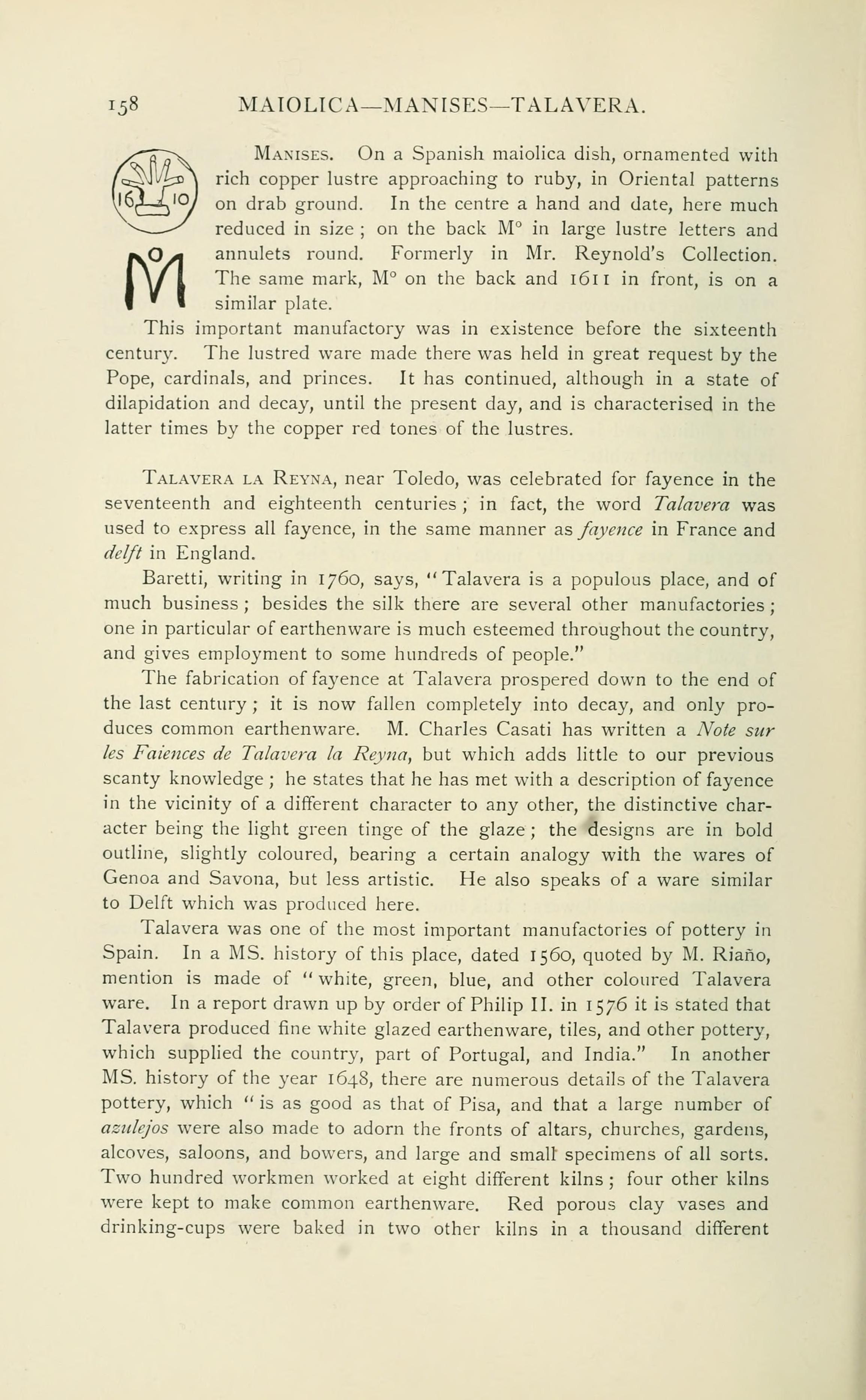
- Talavera la Reyna, near Toledo, was celebrated for fayence in the seventeenth and eighteenth centuries.Chaffers 1891 · p.158
- The word 'Talavera' came to express ALL fayence in Spain, in the same way that 'fayence' does in France and 'delft' in England.Chaffers 1891 · p.158
- Baretti wrote in 1760 that Talavera was a populous place of much business, with a manufactory of earthenware much esteemed throughout the country, giving employment to some hundreds of people. — Chaffers quoting Baretti, 1760Chaffers 1891 · p.158
- The fabrication prospered to the end of the eighteenth century and had by Chaffers' time fallen completely into decay, producing only common earthenware.Chaffers 1891 · p.158
- M. Charles Casati states the distinctive character is the light green tinge of the glaze, with designs in bold outline, slightly coloured, bearing an analogy to the wares of Genoa and Savona but less artistic. — Chaffers quoting Charles Casati, Note sur les Faïences de Talavera la ReynaChaffers 1891 · p.158
- A manuscript history of the place dated 1560, quoted by M. Riaño, mentions white, green, blue and other coloured Talavera ware. — Chaffers quoting MS history of 1560, quoted by RiañoChaffers 1891 · p.158
- A report drawn up by order of Philip II in 1576 states that Talavera produced fine white glazed earthenware, tiles and other pottery, supplying the country, part of Portugal, and India. — Chaffers quoting report to Philip II, 1576Chaffers 1891 · p.158
- A manuscript history of 1648 says the pottery 'is as good as that of Pisa', and that a large number of azulejos were made to adorn the fronts of altars, churches, gardens, alcoves, saloons and bowers. — Chaffers quoting MS history of 1648Chaffers 1891 · p.158
- That same 1648 account records two hundred workmen at eight different kilns, four further kilns kept for common earthenware, and two more for red porous clay vases and drinking-cups. — Chaffers quoting MS history of 1648Chaffers 1891 · p.158
Why this differs from other listings
The most consequential fact here is that 'Talavera' was a generic word for fayence in Spain, exactly as 'delft' became in England. A piece called Talavera may therefore be named for a type rather than a place, which is a different problem from a mark being faked. Chaffers gives what identifies the real thing instead: the light green tinge in the glaze, and bold slightly-coloured outline drawing resembling Genoa and Savona.
The source page
What this entry does not establish
- No Talavera mark is engraved on this page and none is asserted. Attribution rests on the glaze tinge and the drawing style, which is weaker evidence than a mark.
- Most of the dates here come to Chaffers through other authorities — Baretti, Casati, Riaño, and two manuscript histories — and the chain is shown on each claim rather than collapsed into his own voice.
Questions
What marks does Chaffers 1891 record for Talavera la Reyna?
None. The page transcribed for this entry (p.158) records no mark for Talavera la Reyna. That is stated rather than filled in from elsewhere.
What dates does the source give?
None. Chaffers dates no mark on this page, so this entry gives no date either.
Where was Talavera la Reyna?
Talavera la Reyna, near Toledo, Spain. The source also records the name as Talavera.
Can this page tell me what my piece is worth?
No. This site reports what one nineteenth-century reference recorded, and cites the page so you can check it. It does not authenticate objects, value them, or offer an opinion on a specific piece.