Leeds Pottery
Leeds, Yorkshire, England · Pottery · also recorded as Warburton and Britton
Marks
Plate I🔗
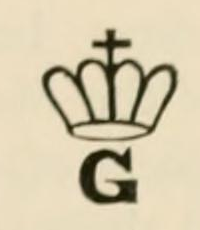
Recorded on a pair of green and white shell-shaped dishes of Leeds pottery.Chaffers 1891, p.729paired by position
Chaffers writes only 'this mark is on a pair of green and white shell-shaped dishes'. The sentence names no letters, so the pairing here is by the mark's position on the page beside it, not by anything the source states.
Plate II🔗
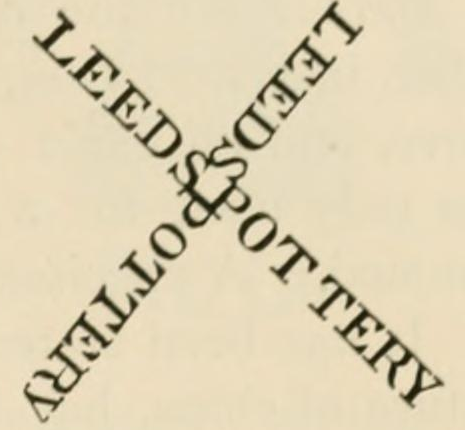
The engraving is set on this page but no sentence on it describes this mark. It is reproduced without a claim attached rather than borrowing a description from elsewhere.
Plate III🔗
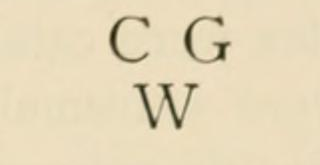
Recorded on a cup and saucer of white English pottery, with paintings of landscapes and the raised wicker border common to this manufactory.Chaffers 1891, p.729
This is the mark Chaffers calls 'that in the margin'.
Plate IV🔗
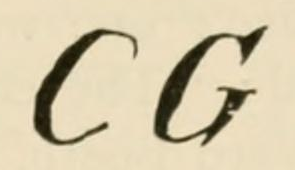
Chaffers writes 'the mark of C. G. has been attributed to Leeds' — a report of an attribution, not a finding of his own.
Plate V🔗
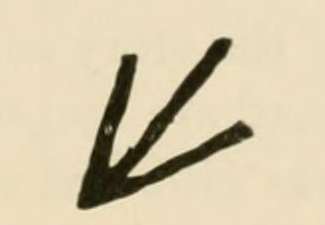
'The arrowhead is also supposed to be an early mark.' The source hedges it and so does this entry.
Plate VI🔗
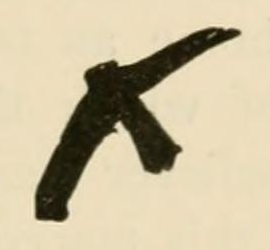
Chaffers engraves two arrowheads on this page and describes them in one sentence without separating them.
What the source records
- Queen's ware was made by most of the makers, and the pieces are found so much alike as to pattern and quality as to render it almost impossible to distinguish one maker from another.Chaffers 1891 · p.729
- A mark on this page is recorded on a pair of green and white shell-shaped dishes of Leeds pottery.Chaffers 1891 · p.729
- The mark of C. G. has been attributed to Leeds.Chaffers 1891 · p.729
- The mark set in the margin is on a cup and saucer of white English pottery, with paintings of landscapes and the raised wicker border common to this manufactory, the letters impressed.Chaffers 1891 · p.729
- The arrowhead is supposed to be an early mark, and occurs on pottery of the same fabric.Chaffers 1891 · p.729
- The manufactory was, when Chaffers wrote, carried on by Messrs. Warburton and Britton, the greater portion of their trade being in toilet services, mugs, pitchers and similar goods in printed transfer ware.Chaffers 1891 · p.729
- A two-handled bell-shaped tyg is recorded, painted with a carpenter at work and his wife bringing him something to drink, with 'John and Ann Aked' written over their heads, and a bouquet and detached flowers in colours on the other side. — Chaffers quoting Mr. T. Fisher's possessionChaffers 1891 · p.729
- A white earthenware tobacco pot with a landscape and figures in blue transfer printing carries the names 'Richard Craven, Hunslett, October 18th, 1815. W. Houldin.' scratched under the glaze on the bottom. — Chaffers quoting the Hon. Roger G. MolyneuxChaffers 1891 · p.729
- Hunslett is a suburb of Leeds, and Chaffers suggests the tobacco pot may have been a gift from one of the workmen of the Leeds Pottery to a friend.Chaffers 1891 · p.729
Why this differs from other listings
The first sentence on this page is the one most Leeds mark lists leave out: Queen's ware was made by most of the makers and the pieces are so alike in pattern and quality that Chaffers calls it almost impossible to tell one maker from another. Every mark below it inherits that caution, and this entry keeps the two together instead of presenting the marks as identifications.
The source page
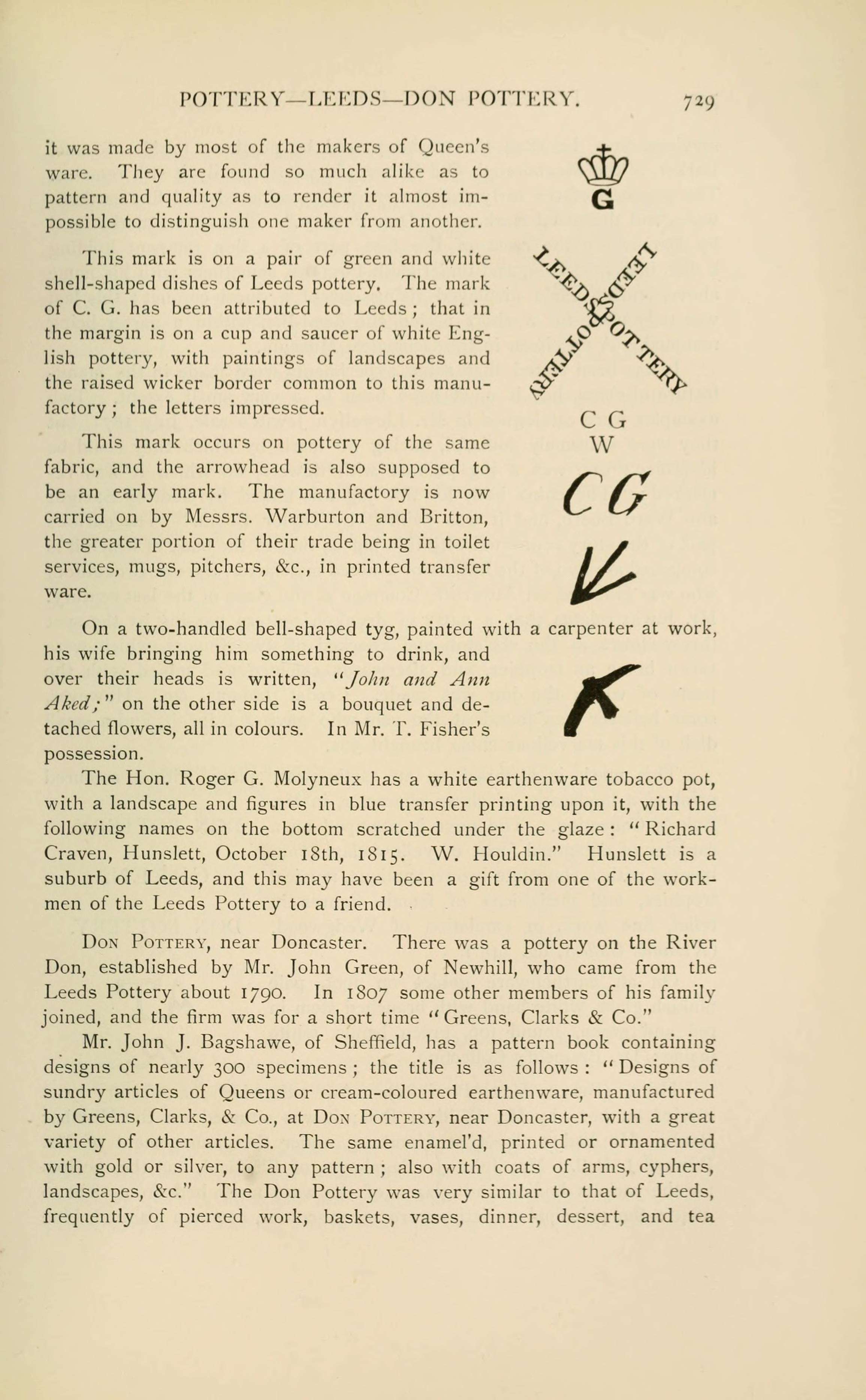
What this entry does not establish
- That any of these marks identifies a Leeds piece on its own. The page opens by saying makers of Queen's ware cannot reliably be told apart by the ware.
- What the crown-over-G mark is. The sentence beside it names no letters; the pairing is positional.
- That C G is Leeds. Chaffers reports the attribution and does not endorse it.
- A date for any mark here. 'Early' is the only temporal word on the page and it is applied to the arrowhead as a supposition.
- Anything about Don Pottery, which shares this page. Its entry needs p.730, which is not fetched.
Questions
What marks does Chaffers 1891 record for Leeds Pottery?
6 on p.729: A crown above the letter G; LEEDS POTTERY twice, crossed saltire-wise; C G above W; C G; An arrowhead; An arrowhead, second form. 6 of them are engraved in the source and are reproduced above; the rest are described in words only.
What dates does the source give?
None. Chaffers dates no mark on this page, so this entry gives no date either.
Where was Leeds Pottery?
Leeds, Yorkshire, England. The source also records the name as Warburton and Britton.
Is the A crown above the letter G attribution certain?
No, and the source says so. Chaffers flags it — paired by position. Chaffers writes only 'this mark is on a pair of green and white shell-shaped dishes'. The sentence names no letters, so the pairing here is by the mark's position on the page beside it, not by anything the source states.
Can this page tell me what my piece is worth?
No. This site reports what one nineteenth-century reference recorded, and cites the page so you can check it. It does not authenticate objects, value them, or offer an opinion on a specific piece.