Copenhagen
Copenhagen, Denmark · Porcelain · also recorded as Royal Copenhagen, Bing & Gröndahl
Marks
Plate I🔗
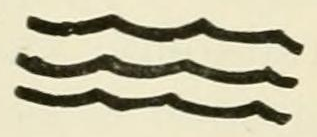
from 1772
Three parallel wavy lines · painted in blue · engraved in the sourceRecorded on a fine tea-service whose plateau carries a portrait of Raffaelle, the other pieces painted with portraits of celebrated painters, in the possession of the Rev. T. Staniforth of Storrs.Chaffers 1891, p.520
The wavy lines are not decorative. Chaffers states what they signify: the Sound, and the Great and Little Belts — the three Danish waterways. The mark is a map.
Plate II🔗
Recorded on a square jardinière painted with figures and trophies of vases and garlands, which also carries the three wavy lines in blue.Chaffers 1891, p.520
A painter's name, not a factory mark. Chaffers notes it appears ALONGSIDE the wavy lines, which is how a signature and a factory mark are told apart on one piece.
Plate III🔗
from 1853
B & G · printed · recorded in words by the source, not drawn — set here as typeChaffers 1891, p.520Bing & Gröndahl. Set in type by Chaffers rather than engraved, so it is shown here as type rather than as a facsimile plate.
What the source records
- The manufactory was commenced by an apothecary named Müller in 1772, making hard paste.Chaffers 1891 · p.520
- Baron Von Lang, from the Furstenburg manufactory, is said to have been instrumental in forming it; it is at least known that he entered the Danish service about the same time.Chaffers 1891 · p.520
- Among the artists employed in painting porcelain about the time of its first establishment were Gylding, Seipsius and Ruch.Chaffers 1891 · p.520
- The capital was raised in shares, but the venture was not successful; the Government interfered and it became a royal establishment in 1775.Chaffers 1891 · p.520
- Chaffers records that it had ever since been maintained at considerable loss.Chaffers 1891 · p.520
- A second Copenhagen porcelain manufactory was established in 1853 and carried on by Messrs Bing & Gröndahl, celebrated especially for biscuit groups and figures after Thorwaldsen, for which they obtained a medal at the International Exhibition of 1862.Chaffers 1891 · p.520
Why this differs from other listings
Almost every listing reproduces the three wavy lines; Chaffers says what they mean — the Sound and the Great and Little Belts. He also separates the two Copenhagen businesses that are routinely conflated: the royal manufactory of 1772 and Bing & Gröndahl of 1853, different firms with different marks.
The source page
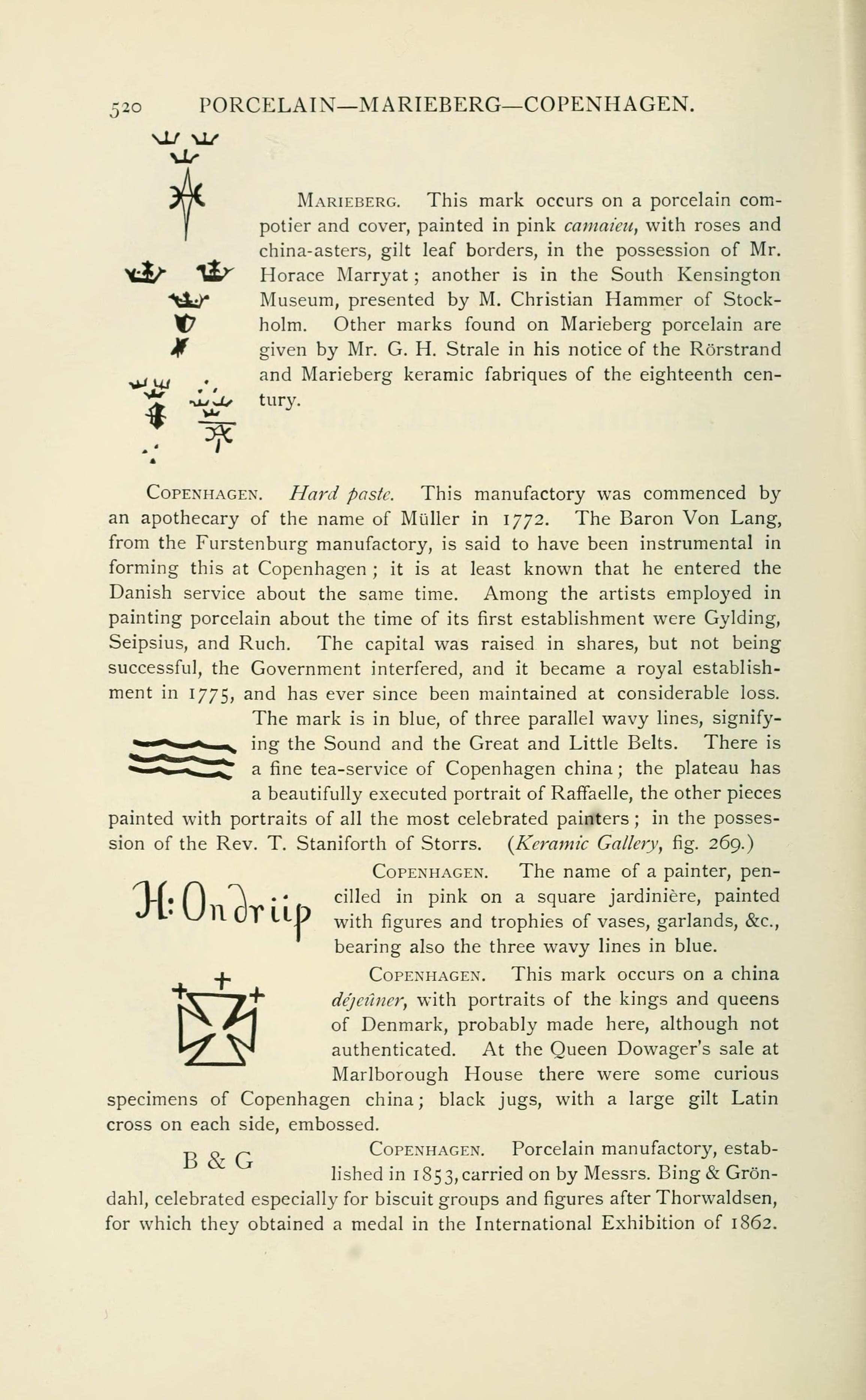
What this entry does not establish
- Chaffers 1891 predates the numbering and dating systems used on twentieth-century Royal Copenhagen, which is what dates most pieces in circulation.
- The cross-like mark he records on a déjeûner with portraits of Danish kings and queens is explicitly NOT authenticated — he says the piece was 'probably made here'. It is therefore not carried as a Copenhagen mark here.
- The Von Lang connection is given as 'said to have been', and is left at that.
Questions
What marks does Chaffers 1891 record for Copenhagen?
3 on p.520: Three parallel wavy lines (from 1772); H: Ondrup; B & G (from 1853). 1 of them are engraved in the source and are reproduced above; the rest are described in words only.
What dates does the source give?
The dates Chaffers attaches to these marks fall between 1772 and 1853. They are his, not an inference drawn here, and several are given as approximate or open-ended in the original wording shown on each plate.
Where was Copenhagen?
Copenhagen, Denmark. The source also records the name as Royal Copenhagen, Bing & Gröndahl.
Can this page tell me what my piece is worth?
No. This site reports what one nineteenth-century reference recorded, and cites the page so you can check it. It does not authenticate objects, value them, or offer an opinion on a specific piece.