Dresden
Meissen, on the Elbe, about twelve miles from Dresden, Saxony · Porcelain · also recorded as Meissen, Königliche Porzellan-Manufaktur
Marks
Plate I🔗
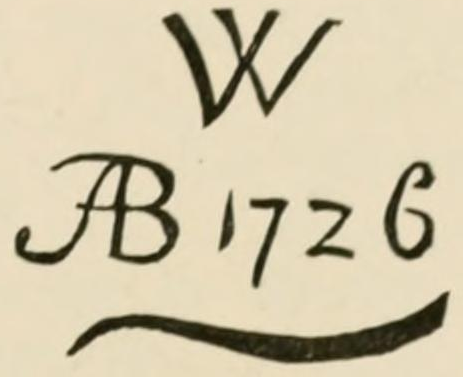
1726
W over ÆB, with the date 1726 · painted in red · engraved in the sourceRecorded on the underside of a saucer painted with terminal figures of the heads and busts of Bacchus and Ariadne, with bold shaded gold scrolls and a panther between; the cup shows infant Bacchanals plucking grapes, and a goat.Chaffers 1891, p.471
A dated mark, which is uncommon. The date is part of the mark rather than added later.
Plate II🔗
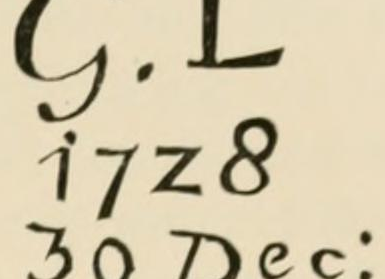
30 December 1728
G.L, 1728, 30 Dec: · painted in gold · engraved in the sourceRecorded on a drinking-cup painted in blue and red camaïeu alternately, with full-length Chinese figures and flowers between.Chaffers 1891, p.471
Dated to the DAY. That is exceptional, and it means the piece can be placed exactly rather than to a period.
Plate III🔗
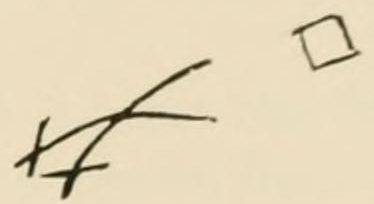
c.1720–30
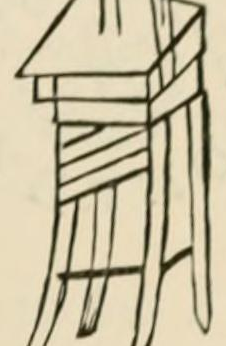
Crossed swords, with a painter's square above · painted in blue · engraved in the sourceChaffers 1891, p.471The crossed swords are the factory mark; the small square above them is the PAINTER'S mark, a separate thing. Chaffers distinguishes the two on this page, which matters because the square is often read as part of the swords.
Plate IV🔗
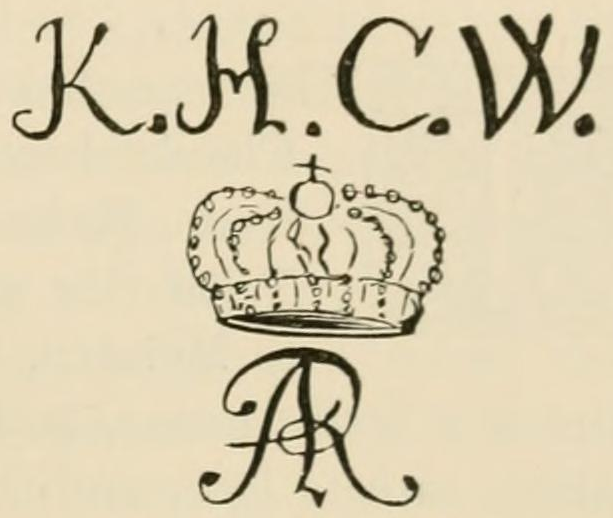
c.1720–30
K.H.C.W. beneath a crowned AR monogram · painted · engraved in the sourceChaffers 1891, p.471K.H.C.W. stands for Königl. Hof. Conditorei, Warschau — the King's Court Confectioner, Warsaw, one of Augustus's principal palaces. The crowned AR is Augustus Rex, King of Poland. So the mark names not the factory but the ROOM the service was made for.
What the source records
- The manufactory was established at Meissen, on the Elbe about twelve miles from Dresden, by Augustus II, King of Poland and Elector of Saxony, for the manufacture of hard paste or true porcelain.Chaffers 1891 · p.461
- The experiments of Tschirnhaus and Böttcher commenced about 1706; the invention of hard paste is attributed to Böttcher.Chaffers 1891 · p.461
- Böttcher's first attempt produced a red ware like jasper, cut and polished by the lapidary and gilt by the goldsmith, made from a kind of brown clay found at Meissen — a fine stoneware with the opacity, grain and toughness of pottery.Chaffers 1891 · p.461
- A square Böttcher-ware coffee-pot with flowers and the head of a boy was in the South Kensington Museum, and a bust of Böttcher himself in the same ware in the Right Hon. W. E. Gladstone's Collection.Chaffers 1891 · p.461
- Tschirnhaus died in 1708, and shortly afterwards Böttcher succeeded in making white porcelain through the accidental detection of the kaolin necessary for it.Chaffers 1891 · p.461
- The kaolin story: John Schnorr, a rich ironmaster of the Erzgebirge, riding at Aue near Schneeberg in 1711, noticed his horse's feet sticking in a soft white clay. Hair-powder for wigs was then made chiefly from wheat-flour, and the earth was examined as a cheaper substitute and sold in quantity at Dresden and Leipzig. Böttcher used it, found it much heavier than expected, and analysed it.Chaffers 1891 · p.461
- A service painted in blue camaïeu with flowers and insects, bearing the crossed swords with a square painter's mark and the initials K.H.C.W., was made specially for the King's use about 1720–30 and was in the possession of Herr Pollak of Vienna.Chaffers 1891 · p.471
Why this differs from other listings
Two of these four marks carry dates, and one carries a day — 30 December 1728. That is rare enough on porcelain to be worth the page on its own. The other useful separation is that the small square beside the crossed swords is a painter's mark, not part of the factory mark, and that K.H.C.W. identifies a destination rather than a maker: the King's Court Confectionery at Warsaw.
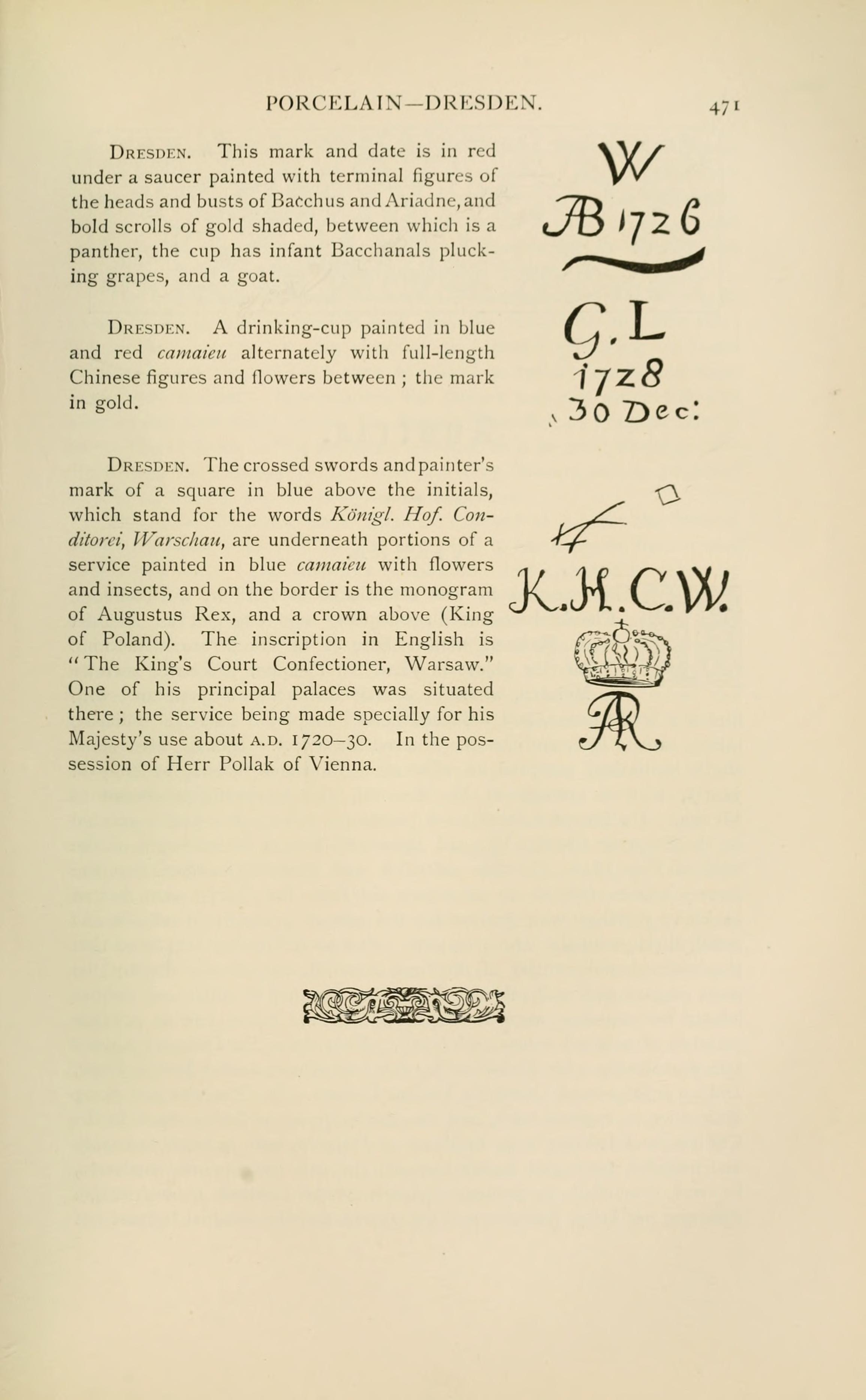
The source page
What this entry does not establish
- Chaffers 1891 predates the systematic dating of Meissen crossed-swords variants that collectors now use. Nothing here dates a piece by the form of the swords.
- The kaolin discovery story is given as a story — 'the story is thus told' — and Chaffers does not vouch for the detail.
- This entry covers pages 461 and 471 only. The Dresden section runs across many pages that are not yet transcribed.
Questions
What marks does Chaffers 1891 record for Dresden?
4 on p.471: W over ÆB, with the date 1726 (1726); G.L, 1728, 30 Dec: (30 December 1728); Crossed swords, with a painter's square above (c.1720–30); K.H.C.W. beneath a crowned AR monogram (c.1720–30). 4 of them are engraved in the source and are reproduced above; the rest are described in words only.
What dates does the source give?
The dates Chaffers attaches to these marks fall between 1720 and 1728. They are his, not an inference drawn here, and several are given as approximate or open-ended in the original wording shown on each plate.
Where was Dresden?
Meissen, on the Elbe, about twelve miles from Dresden, Saxony. The source also records the name as Meissen, Königliche Porzellan-Manufaktur.
Can this page tell me what my piece is worth?
No. This site reports what one nineteenth-century reference recorded, and cites the page so you can check it. It does not authenticate objects, value them, or offer an opinion on a specific piece.