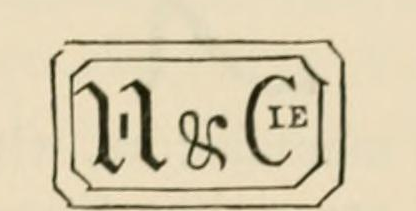
Lane Delph and Fenton
Lane Delph and Fenton, Staffordshire, England · Pottery · also recorded as Fenton Stone Works, R. Minton Taylor & Co, The Foley
Marks
Plate I🔗

The only mark engraved on this page. The surrounding entries — Heath, Edwards, Phillips, Matthews, Adams and Prince — are recorded by name and date with no mark given, which is why this entry lists them as history rather than as attributions.
What the source records
- Thomas Heath made a good kind of pottery at Lane Delph in 1710, by mixing a clay obtained from the coal-mines with his other clays; the result was durable and not easily affected by change or excess of temperature.Chaffers 1891 · p.674
- Heath's three daughters married men who afterwards became celebrated potters — Mr Neale of London, Mr Palmer of Hanley and Mr Pratt of Fenton.Chaffers 1891 · p.674
- William Edwards made very good coloured earthenware at Lane Delph in 1750.Chaffers 1891 · p.674
- Mr Phillips was an eminent manufacturer at Lane Delph; a fine cream-colour inkstand of his making is dated 1760.Chaffers 1891 · p.674
- W. Matthews of Lane Delph made mottled and clouded pottery; his drinking-mugs are well handled and finely rolled but have no spout.Chaffers 1891 · p.674
- John Adams and John Prince manufactured red porcelain and white salt-glazed stoneware at Lane Delph about 1750–60 and realised large fortunes.Chaffers 1891 · p.674
- The Foley manufactory was erected by the elder Josiah Spode for his second son Samuel Spode, whose name appears in the map of 1802; it was occupied by Charles Bourne in 1829 and stood empty in 1843.Chaffers 1891 · p.674
- Robert Minton Taylor, nephew of Herbert Minton, was formerly managing partner of the tile department at Minton's of Stoke-upon-Trent before running an extensive manufactory of encaustic and majolica tiles at Fenton under the style R. Minton Taylor & Co.Chaffers 1891 · p.674
Why this differs from other listings
This is the unglamorous half of Staffordshire: a run of small Lane Delph makers with dates but no marks. Chaffers records who worked where and when — Heath in 1710, Edwards in 1750, Adams and Prince in 1750–60, the Foley passing from Samuel Spode to Charles Bourne in 1829 and standing empty by 1843 — which is the context that lets an unmarked local piece be placed at all.
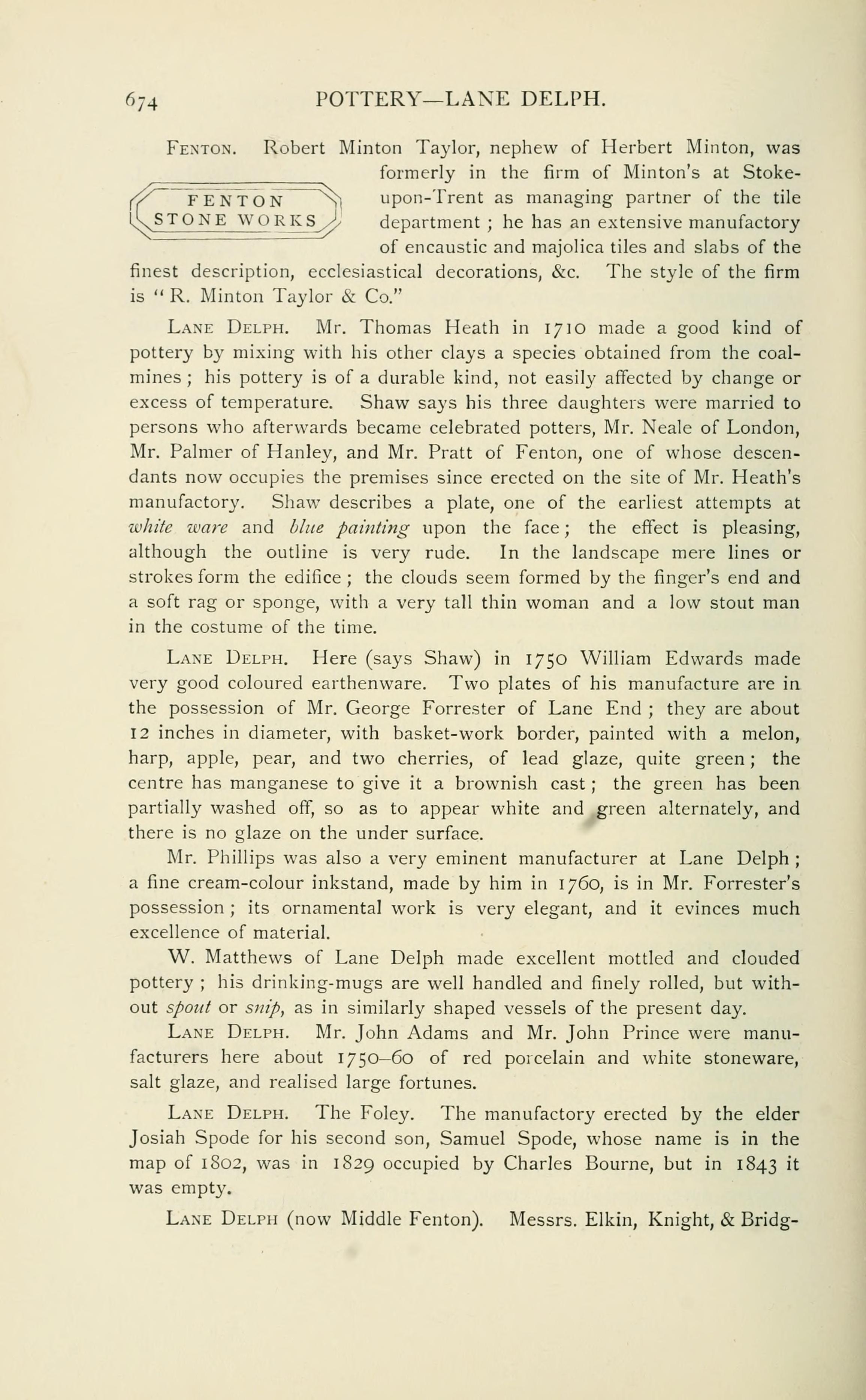
The source page
What this entry does not establish
- Most makers named on this page have NO mark recorded. An unmarked Lane Delph piece cannot be attributed to any of them from this source.
- Chaffers takes much of this from Shaw, and says so; the chain is this page to Shaw to the events, not first-hand observation.
Questions
What marks does Chaffers 1891 record for Lane Delph and Fenton?
1 on p.674: FENTON STONE WORKS, in a cartouche. 1 of them are engraved in the source and are reproduced above; the rest are described in words only.
What dates does the source give?
None. Chaffers dates no mark on this page, so this entry gives no date either.
Where was Lane Delph and Fenton?
Lane Delph and Fenton, Staffordshire, England. The source also records the name as Fenton Stone Works, R. Minton Taylor & Co, The Foley.
Can this page tell me what my piece is worth?
No. This site reports what one nineteenth-century reference recorded, and cites the page so you can check it. It does not authenticate objects, value them, or offer an opinion on a specific piece.