Pinxton
Pinxton, Derbyshire, England · Porcelain · also recorded as John Coke, Billingsley, Cutts
Marks
Plate I🔗
before c.1812
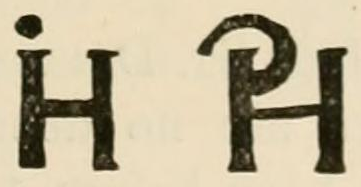
An italic script letter · painted · recorded in words by the source, not drawn — set here as typeRecorded on a piece purchased at the works by the grandfather of Mr E. M. Kidd of Nottingham.Chaffers 1891, p.757
Chaffers sets this as a small inline glyph in the running text rather than engraving it in the margin, so it is shown here as type. It is the only factory mark he gives for Pinxton on this page.
Plate II🔗
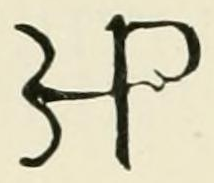
Recorded on a quart jug presented by Mr Cutts, the proprietor, to Joseph and Mary Simpson.Chaffers 1891, p.757not a factory mark
A presentation inscription for two named people, not a maker's mark. It is recorded here because it is easily mistaken for one — the initials of a recipient look exactly like the initials of a firm.
What the source records
- The china made at Pinxton was soft paste and very translucent, similar to that afterwards produced at Nantgarw by Billingsley.Chaffers 1891 · p.757
- Billingsley left the concern at the beginning of the nineteenth century; it was carried on by Mr Coke alone for seven or eight years.Chaffers 1891 · p.757
- Mr Cutts, a painter who had been Billingsley's foreman, then took the works; they were altogether discontinued about 1812 and Cutts went into Staffordshire.Chaffers 1891 · p.757
- A favourite pattern was called the 'French sprig' or 'Chantilly', known in the Derby works as the '129 sprig' — an imitation of Angoulême china, painted with a forget-me-not or small blue corn-flower and a gold sprig on the white, edged with gold.Chaffers 1891 · p.757
- Pinxton wares never carried raised flowers, unlike the Derby ware; when not edged with gold the edging was usually blue and sometimes a marone colour.Chaffers 1891 · p.757
- Billingsley kept the receipt for mixing his ingredients entirely in his own possession and never divulged it; at his death it came into the hands of his employer, Mr Rose of Coalport.Chaffers 1891 · p.757
- Three tokens of Pinxton porcelain in the British Museum, about 1⅛ inches in diameter, are marked in figures for 5s., 7s. and 10s., inscribed 'Let the bearer have in goods 7' and on the reverse 'Which place to the account of John Coke, Pinxton, Dec. 4, 1801.'Chaffers 1891 · p.757
- Mrs Vallance, a gold burnisher at the works, remembered Billingsley, Slater, Marriott and Musgrove as painters, and several hands who came from Derby, George Mellor among them.Chaffers 1891 · p.757
- Sir Joseph and Lady Banks visited the works in 1810 and purchased three hampers of china.Chaffers 1891 · p.757
Why this differs from other listings
Pinxton is barely marked, and Chaffers is honest about it: one italic letter, set inline rather than engraved. What he gives instead is the means to identify unmarked pieces — the soft translucent paste, the '129 sprig' pattern and its Angoulême original, the absence of raised flowers that separates it from Derby, and the blue or marone edging where there is no gilding. He also dates the works closed to about 1812.
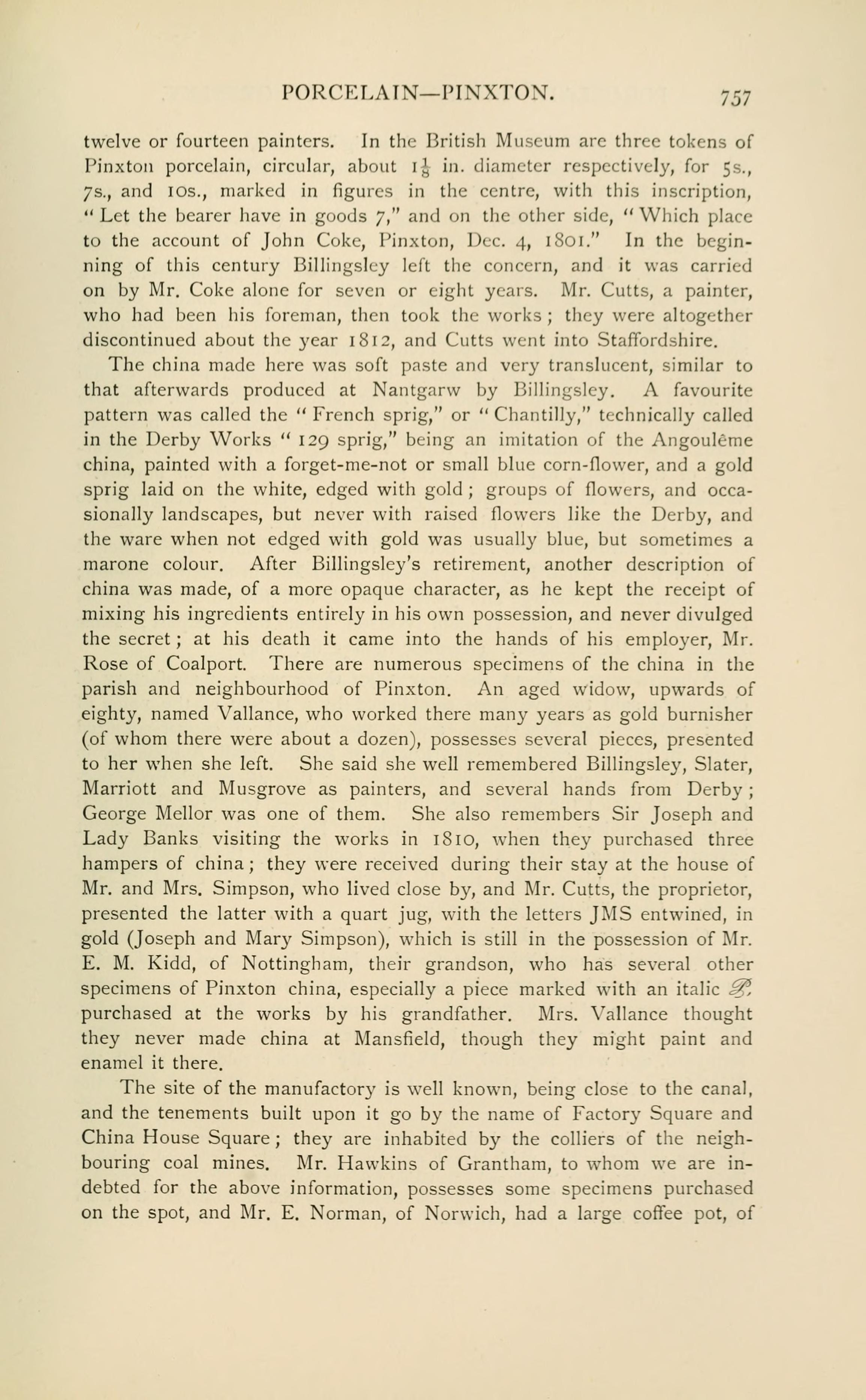
The source page
What this entry does not establish
- Pinxton has no reliable factory mark. Attribution here rests on paste and pattern, which is weaker evidence than a stamp and should be treated as such.
- The JMS jug is a presentation piece. Its initials say nothing about the maker.
- The tokens are trade tokens issued on John Coke's account, not wares, and their 1801 date belongs to the token rather than to any piece of china.
Questions
What marks does Chaffers 1891 record for Pinxton?
2 on p.757: An italic script letter (before c.1812); JMS entwined, in gold. 0 of them are engraved in the source and are reproduced above; the rest are described in words only.
What dates does the source give?
The dates Chaffers attaches to these marks fall between 1812. They are his, not an inference drawn here, and several are given as approximate or open-ended in the original wording shown on each plate.
Where was Pinxton?
Pinxton, Derbyshire, England. The source also records the name as John Coke, Billingsley, Cutts.
Is the JMS entwined, in gold attribution certain?
No, and the source says so. Chaffers flags it — not a factory mark. A presentation inscription for two named people, not a maker's mark. It is recorded here because it is easily mistaken for one — the initials of a recipient look exactly like the initials of a firm.
Can this page tell me what my piece is worth?
No. This site reports what one nineteenth-century reference recorded, and cites the page so you can check it. It does not authenticate objects, value them, or offer an opinion on a specific piece.