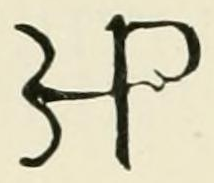
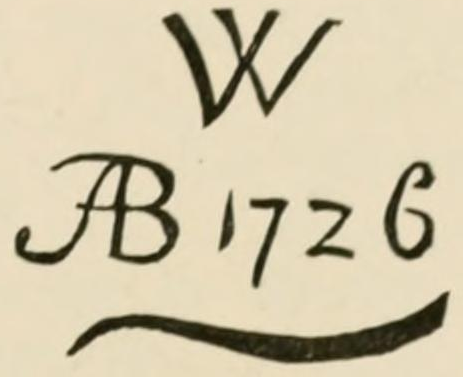
Strasbourg
Strasbourg, Basse-Rhin, France · Porcelain · also recorded as Strassburg, Hannong
Marks
Plate I🔗
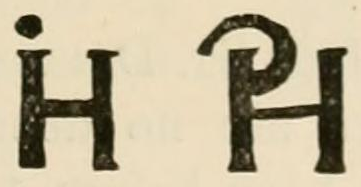
The marks of Paul Hannong. Chaffers gives these as the Strasbourg marks — the factory is identified by the man, not by a house device.
Plate II🔗
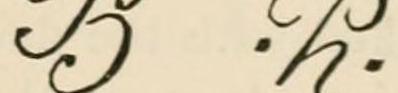
A second generation of the same family and a different hand. Chaffers separates them from the marks above rather than treating them as variants.
Plate III🔗
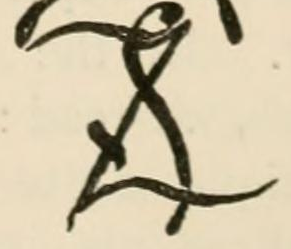
Recorded on German porcelain cups and saucers painted with bouquets, from a tea-service in the possession of the Rev. T. Staniforth and Mr Franks.Chaffers 1891, p.543
Chaffers records this on hard-paste pieces he describes as GERMAN porcelain, not French — which fits the Frankenthal removal rather than contradicting it.
What the source records
- Established in 1752 by Paul Hannong, making hard paste.Chaffers 1891 · p.543
- About 1752 Hannong obtained the secret of true porcelain from Ringler.Chaffers 1891 · p.543
- Because of the monopoly held by Sèvres he was compelled to relinquish it, and in 1753 removed to Frankenthal, where he was received with open arms.Chaffers 1891 · p.543
- By 1761 the work greatly flourished under the protection of the Elector Palatine, Carl Theodore.Chaffers 1891 · p.543
- Chaffers states plainly that the Strasbourg marks are those of Hannong.Chaffers 1891 · p.543
Why this differs from other listings
Strasbourg and Frankenthal are usually treated as separate entries, which hides why they share a hand. Chaffers gives the causal chain in one paragraph: Hannong got the hard-paste secret from Ringler in 1752, the Sèvres monopoly forced him to give it up, and he took it to Frankenthal in 1753. A Hannong monogram is therefore evidence about a man moving between two places, not about one factory.
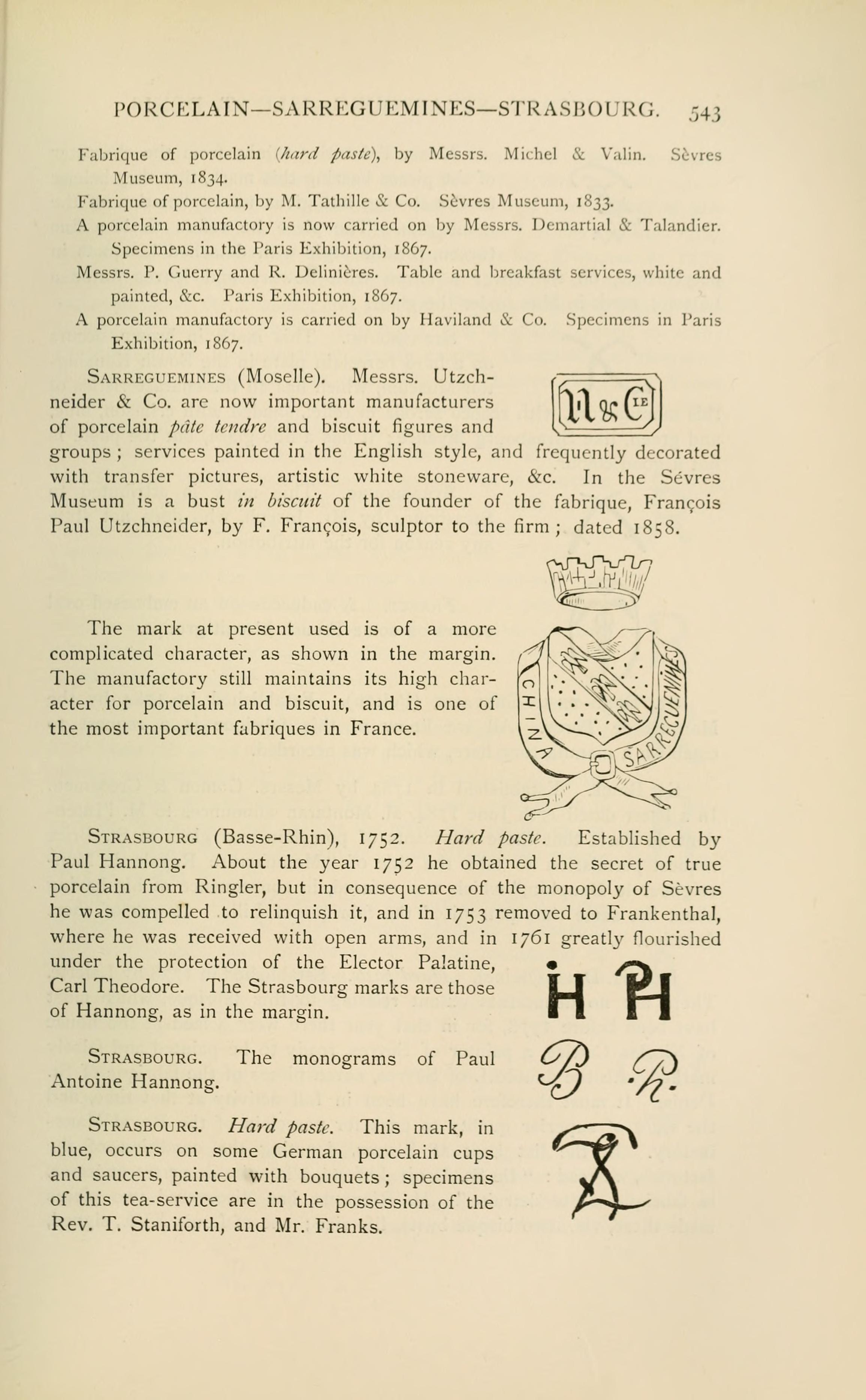
The source page
What this entry does not establish
- Chaffers does not give date ranges for the individual Hannong monograms on this page, so none is asserted here.
- The Sarreguemines entry shares this page and is not yet transcribed: its marks are engraved as a crowned shield that the current crop tool splits and truncates, and a broken plate is worse than none.
Questions
What marks does Chaffers 1891 record for Strasbourg?
3 on p.543: H, and PH in monogram; Monograms of Paul Antoine Hannong; Hannong monogram in blue. 3 of them are engraved in the source and are reproduced above; the rest are described in words only.
What dates does the source give?
None. Chaffers dates no mark on this page, so this entry gives no date either.
Where was Strasbourg?
Strasbourg, Basse-Rhin, France. The source also records the name as Strassburg, Hannong.
Can this page tell me what my piece is worth?
No. This site reports what one nineteenth-century reference recorded, and cites the page so you can check it. It does not authenticate objects, value them, or offer an opinion on a specific piece.