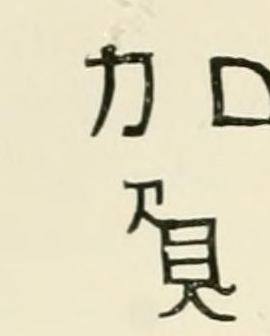
Satsuma
Nawashiro-gawa, province of Satsuma, Kiu-Siu, Japan · Fayence · also recorded as Satsuma-Yaki, Nawashiro-gawa
Marks
Plate I🔗
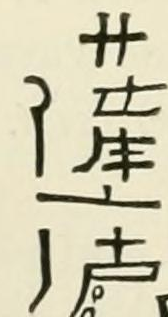
Chaffers engraves this as the mark of the PROVINCE rather than of a workshop. It identifies where a piece was made, not who made it.
What the source records
- Satsuma is a province in the south-west of the island of Kiu-Siu, governed by the Prince of Satsuma.Chaffers 1891 · p.416
- The body is of pipeclay, usually buff or cream, soft and porous, slightly baked, with a thick transparent but imperfect glaze whose surface is covered entirely with minute cracks.Chaffers 1891 · p.417
- The ornamentation is applied UPON the glaze, many pieces painted in gold and colours with figures, flowers, birds and conventional designs.Chaffers 1891 · p.417
- Ancient examples have a grey glaze and a peculiar waxy appearance, and are much prized.Chaffers 1891 · p.417
- Chaffers likens the body to Henri Deux ware more than to anything else he had handled.Chaffers 1891 · p.417
- Pottery was introduced to the province from Corea about 1470, when a kind of stoneware was made along with a white ware resembling Corean white porcelain.Chaffers 1891 · p.417
- The finely crackled ware dates from about 1592, when the Prince of Satsuma settled several Corean potters and their families in his province — first at Kagoshima, afterwards at Chiusa in the province of Ohosoumi, and then at Nawashiro-gawa.Chaffers 1891 · p.417
- Decoration in gold commenced about 1630.Chaffers 1891 · p.417
- Demand at the port of Yokohama caused many cheap imitations of the old ware to be manufactured for the London market, especially at Yedo and Awata.Chaffers 1891 · p.417
- Great quantities of modern Kioto ware were invoiced to Britain by European agents as Satsuma fayence and catalogued and sold as such.Chaffers 1891 · p.417
- Modern Kioto ware is distinguished by a full buff tint, a light and porous body, and a bright glassy crackled varnish; the hard or semi-porcelain character of genuine Satsuma is entirely absent.Chaffers 1891 · p.417
- An imitation Satsuma was made at Ota, a suburb of Yokohama, by a potter named Ko-zan, and sometimes bears his mark in a gourd-shaped cartouch.Chaffers 1891 · p.417
- The ten specimens of Satsuma in the Japanese Collection were all made at Nawashiro-gawa and range in date from 1720 to 1875.Chaffers 1891 · p.417
Why this differs from other listings
The line that matters most on this page is a warning about marks themselves: genuine Satsuma 'is not always marked; all those which are evidently imitations are, like Satsuma, unmarked.' An absent mark is therefore evidence of nothing in either direction. What Chaffers offers instead is a physical test — genuine Satsuma has a hard or semi-porcelain character that modern Kioto ware entirely lacks, and Kioto reads as a full buff tint, light and porous, under a bright glassy varnish. He also names the specific imitation centres, Yedo, Awata and Ota, and one imitator, Ko-zan of Ota, whose mark sits in a gourd-shaped cartouch.
The source page
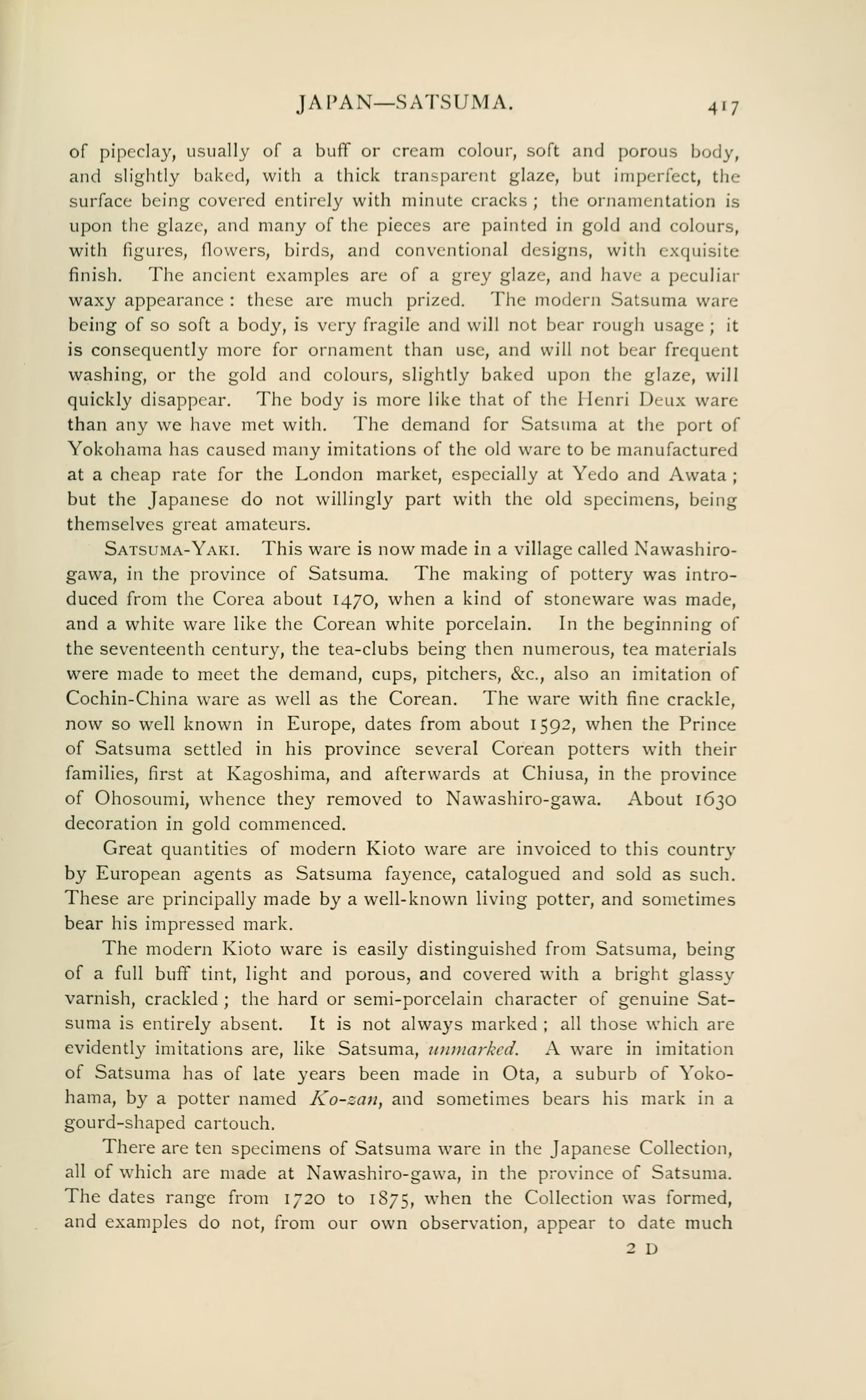
What this entry does not establish
- The province character says where, not who, and Chaffers does not tie it to a workshop or a date range.
- Chaffers wrote while the imitation trade was active, so 'modern' here means late-nineteenth-century, not recent.
- The Ko-zan gourd cartouch is described but not engraved on this page, so no plate for it is shown.
Questions
What marks does Chaffers 1891 record for Satsuma?
1 on p.417: The Satsuma province character. 1 of them are engraved in the source and are reproduced above; the rest are described in words only.
What dates does the source give?
None. Chaffers dates no mark on this page, so this entry gives no date either.
Where was Satsuma?
Nawashiro-gawa, province of Satsuma, Kiu-Siu, Japan. The source also records the name as Satsuma-Yaki, Nawashiro-gawa.
Can this page tell me what my piece is worth?
No. This site reports what one nineteenth-century reference recorded, and cites the page so you can check it. It does not authenticate objects, value them, or offer an opinion on a specific piece.