Amsterdam
Flacke-feld, near the Gate of Weesp, Amsterdam, Holland · Fayence · also recorded as Hartog Van Laun & Brandeis, Flacke-feld
Marks
Plate I🔗
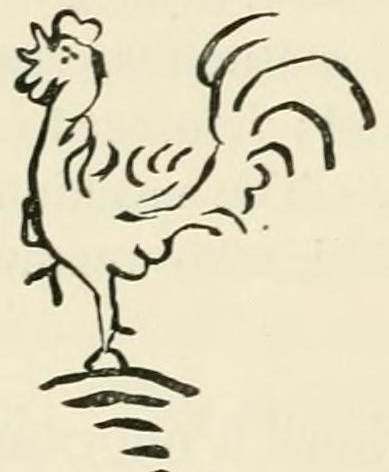
c.1780–1785
A chanticleer proclaiming the dawn · painted · engraved in the sourceRecorded on a piece given by a son of Brandeis to M. Demmin, and a fruit-dish painted in lilac camaïeu with peasants dancing.Chaffers 1891, p.258
A pictorial mark rather than initials or a monogram, which makes it unusually easy to recognise and unusually easy to confuse with the many other cockerel devices used across European pottery.
What the source records
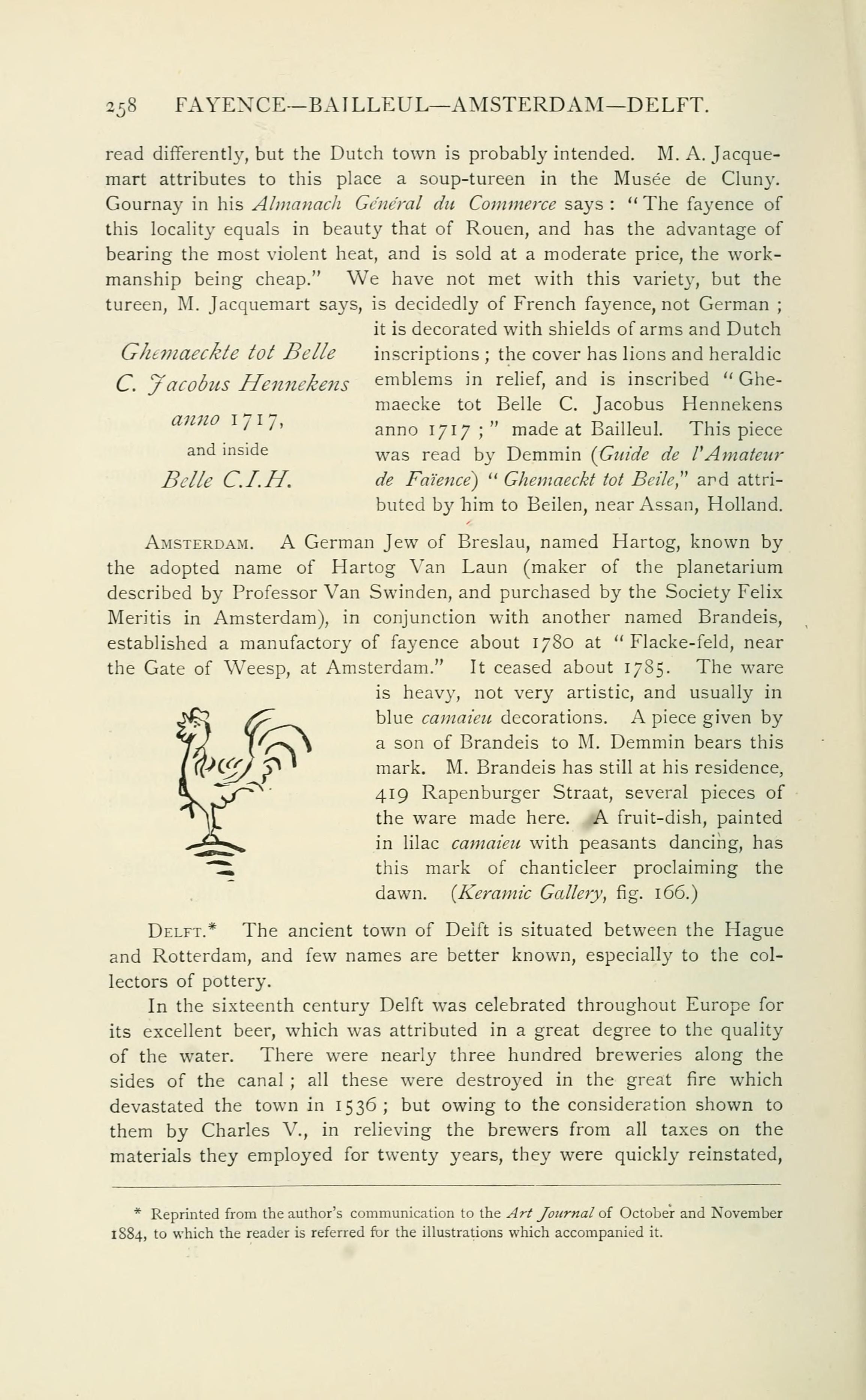
- A manufactory of fayence was established about 1780 at Flacke-feld, near the Gate of Weesp, at Amsterdam.Chaffers 1891 · p.258
- It was founded by Hartog, a German Jew of Breslau known by the adopted name Hartog Van Laun, in conjunction with another named Brandeis.Chaffers 1891 · p.258
- Hartog Van Laun also made the planetarium described by Professor Van Swinden and purchased by the Society Felix Meritis in Amsterdam.Chaffers 1891 · p.258
- The manufactory ceased about 1785 — an operating life of roughly five years.Chaffers 1891 · p.258
- The ware is heavy, not very artistic, and usually decorated in blue camaïeu.Chaffers 1891 · p.258
- Chaffers records that M. Brandeis still held several pieces of the ware at his residence, 419 Rapenburger Straat, at the time of writing.Chaffers 1891 · p.258
Why this differs from other listings
This factory ran for about five years and closed in 1785, so the window in which the chanticleer mark could have been applied is narrow and precisely stated. That is more useful for dating a piece than most attributions, and it comes with the maker's address — Chaffers names the house where surviving pieces were still held.
The source page
What this entry does not establish
- Chaffers does not say the chanticleer was the only mark used, and a five-year operation may have used none on much of its output.
- A cockerel device is not diagnostic on its own. Other European potteries used one, and this entry is evidence about this factory's mark, not a rule for reading every rooster.
Questions
What marks does Chaffers 1891 record for Amsterdam?
1 on p.258: A chanticleer proclaiming the dawn (c.1780–1785). 1 of them are engraved in the source and are reproduced above; the rest are described in words only.
What dates does the source give?
The dates Chaffers attaches to these marks fall between 1780. They are his, not an inference drawn here, and several are given as approximate or open-ended in the original wording shown on each plate.
Where was Amsterdam?
Flacke-feld, near the Gate of Weesp, Amsterdam, Holland. The source also records the name as Hartog Van Laun & Brandeis, Flacke-feld.
Can this page tell me what my piece is worth?
No. This site reports what one nineteenth-century reference recorded, and cites the page so you can check it. It does not authenticate objects, value them, or offer an opinion on a specific piece.