Capo di Monte
Naples, Italy · Porcelain · also recorded as Capodimonte, Naples
Marks
Plate I🔗
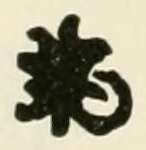
earliest period, from 1736
A fleur-de-lis · painted in blue, generally roughly · engraved in the sourceChaffers 1891, p.428Chaffers gives the fleur-de-lis as the EARLIEST mark and notes it is generally roughly painted. The crowned N that most people associate with Capo di Monte belongs to a later period and is the form most often faked.
What the source records
- The manufactory was founded by Charles III in 1736, making soft paste.Chaffers 1891 · p.428
- Chaffers considers the art of native origin, reasoning that the secret kept so profoundly at Dresden could scarcely have reached Naples that early, and that the character of the productions is essentially different.Chaffers 1891 · p.428
- The King himself took great interest in the works and is said to have worked occasionally in the manufactory.Chaffers 1891 · p.428
- Starrien Porter, writing to Mr Pitt (Lord Chatham) on 8 April 1760, recorded that during the annual fairs in the square before the palace at Naples there was a shop solely for the sale of the King's china, and that a note of the articles sold and the names of the purchasers was brought to the King each morning.Chaffers 1891 · p.428
- On obtaining the crown of Spain the King took twenty-two persons with him to form his establishment at Madrid.Chaffers 1891 · p.428
- The beautiful services and groups in coloured relief belong to the second period, about 1760.Chaffers 1891 · p.428
- The manufactory was discontinued in 1821 and its early moulds were transferred to Doccia.Chaffers 1891 · p.426
Why this differs from other listings
The famous crowned N is not the earliest Capo di Monte mark — the fleur-de-lis is, roughly painted in blue. And Chaffers explains why any Capo di Monte mark is weak evidence: the moulds went to Doccia in 1821, Doccia imitated the mark, and Europe filled up with false examples that could be bought openly at the Doccia works. That is a documented mechanism for the forgeries, not a warning in the abstract.
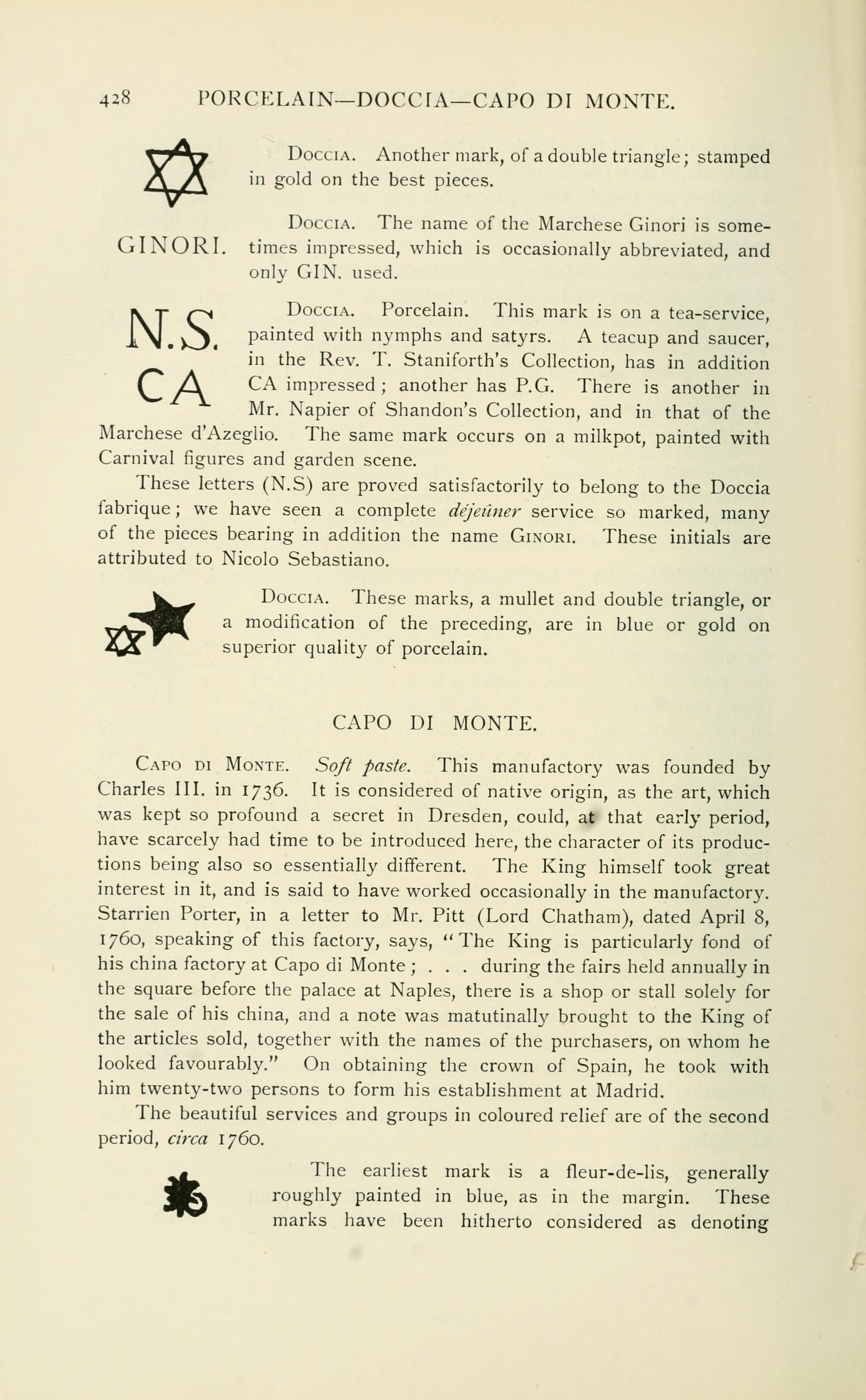
The source page
What this entry does not establish
- This page gives the earliest mark only. The later crowned N is not transcribed here and should not be inferred from this entry.
- Because Doccia reproduced both the moulds and the mark after 1821, a Capo di Monte mark alone does not establish a Capo di Monte piece. Chaffers is explicit about this and it is the reason to be careful rather than confident.
- Chaffers' claim of 'native origin' is his reasoning from the character of the ware, not documentary evidence.
Questions
What marks does Chaffers 1891 record for Capo di Monte?
1 on p.428: A fleur-de-lis (earliest period, from 1736). 1 of them are engraved in the source and are reproduced above; the rest are described in words only.
What dates does the source give?
The dates Chaffers attaches to these marks fall between 1736. They are his, not an inference drawn here, and several are given as approximate or open-ended in the original wording shown on each plate.
Where was Capo di Monte?
Naples, Italy. The source also records the name as Capodimonte, Naples.
Can this page tell me what my piece is worth?
No. This site reports what one nineteenth-century reference recorded, and cites the page so you can check it. It does not authenticate objects, value them, or offer an opinion on a specific piece.